Farlands Odyssey vs AI Dungeon: Which Wins in 2026?
Farlands Odyssey vs AI Dungeon compared: combat, pricing, memory, multiplayer and visuals. Find out which AI game master fits your play style.

Farlands Odyssey vs AI Dungeon: Which AI Game Master Actually Plays Like an RPG? (2026 Comparison)
Introduction
Full disclosure: we built Farlands Odyssey, so this Farlands Odyssey vs AI Dungeon comparison isn't coming from nowhere. We're still going to call it straight. AI Dungeon (2019, Latitude) defined the category: freeform AI storytelling with a GM-like narrator, a large and established user base, mobile apps, and near‑limitless creativity. It's the default people compare everything to. Farlands Odyssey (early access 2026 at farlandsodyssey.com) came from wanting an actual RPG experience - dice, stats, spell slots, persistent worlds - without needing a rulebook or a group. This comparison covers combat depth, memory, pricing, multiplayer, visual versus text‑only play, and which style each serves. If what you actually want is a real RPG, not just a story engine, it's worth a look.
Quick Verdict: Farlands Odyssey vs AI Dungeon – Which Wins?
For anyone who wants to actually play an RPG, not just co-write a story, Farlands Odyssey is the better pick. AI Dungeon still leads for pure freeform writing.
Farlands Odyssey wins if you want a rules-light RPG that still feels like one - real action economy, spell slots, stat checks, persistent inventory that carries between sessions, and companion NPCs who travel with you. Free to start; paid plans from $7/mo at farlandsodyssey.com/plans.
AI Dungeon wins if you want the widest possible freedom to write any story, in any genre, with minimal rules friction. The premium tiers ($14.99–$99.99/mo) unlock larger contexts and better models.
Neither wins if what you actually want is a custom LLM playground - ChatGPT or Claude with a roleplay prompt will serve that use case for less money.
What We're Comparing: Farlands Odyssey vs AI Dungeon – Two Philosophies
AI Dungeon has been around since 2019. It's designed for open-ended story generation rather than enforcing game rules. The AI is a co-author, there to let you write any story you want.
Farlands Odyssey started because we wanted to play D&D and couldn't get a group together. The existing AI RPG tools we tried didn't properly track game state and combat, so we built an AI that is a game engine first - it tracks HP, spell slots, action economy, inventory, and world state automatically, then weaves that state into the narrative as it tells the story.
That philosophy difference runs through everything. Combat here uses a real action economy (actions and bonus actions shown as pips), spell slots by level, and dice-based stat checks, all tracked automatically so you never touch a rulebook. Farlands Odyssey remembers your character sheet and world state between sessions - come back a week later and your inventory is still there. Character progression: your character sheet and stats are tracked automatically. Multiplayer in Farlands Odyssey is a shared campaign with turn-based combat and a host whose message pool covers the whole party (see plans for details).
That's a genuine design choice on both sides. We'll go over where it shows up most throughout this comparison.
Combat Systems: Open-Ended Story vs. Actual RPG Mechanics
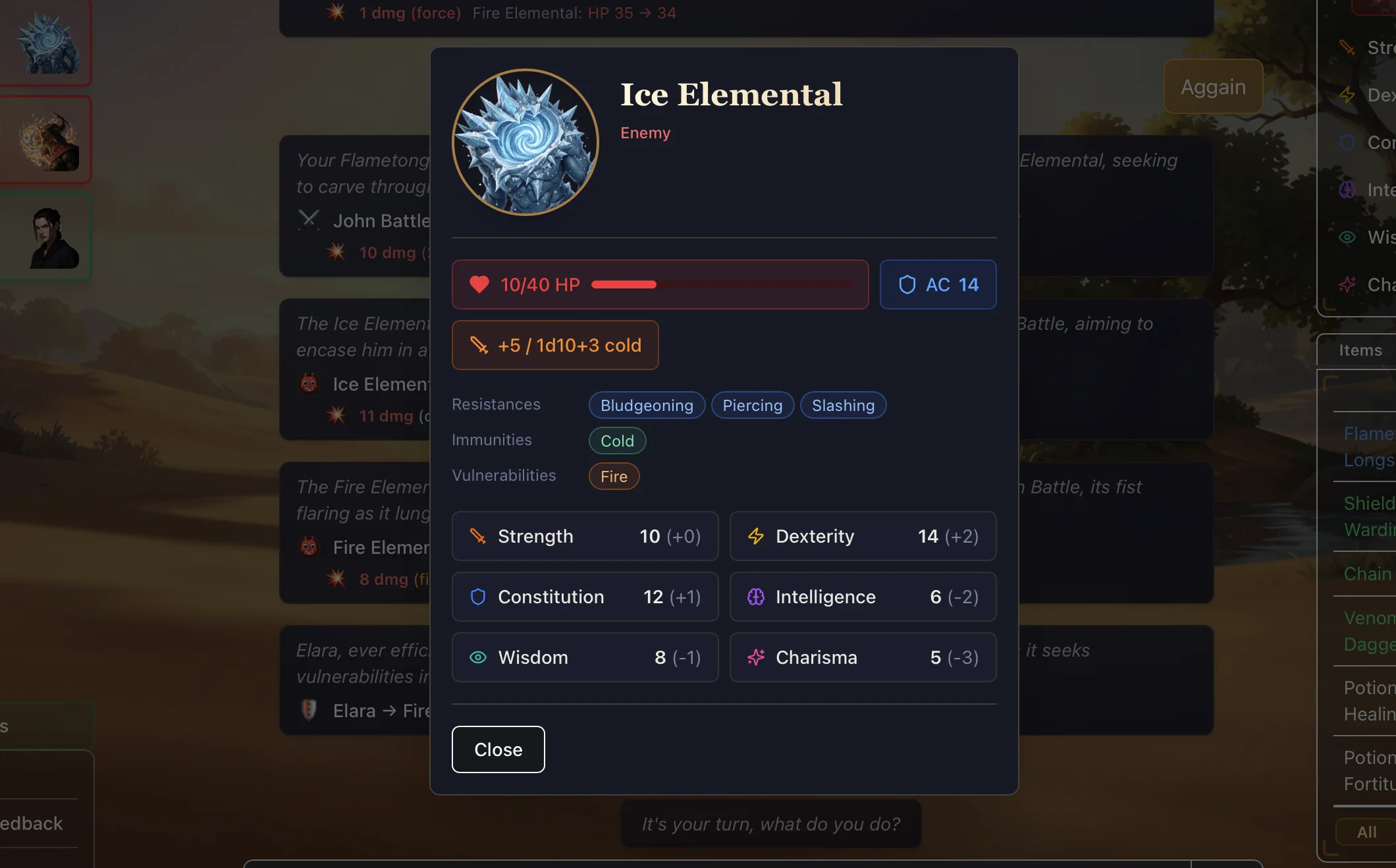
Combat is where the two philosophies diverge most sharply. In AI Dungeon, combat is reportedly freeform: you describe your action, the AI narrates the outcome, without hit points, attack rolls, or turn order built in - unless you manually track them in a notes file and ask the AI to respect them. The AI is trusted to simulate fair outcomes, which works great for storytelling but can be less consistent for tactics. Without an engine enforcing the numbers, outcomes can shift from scene to scene depending on how the AI is narrating in the moment.
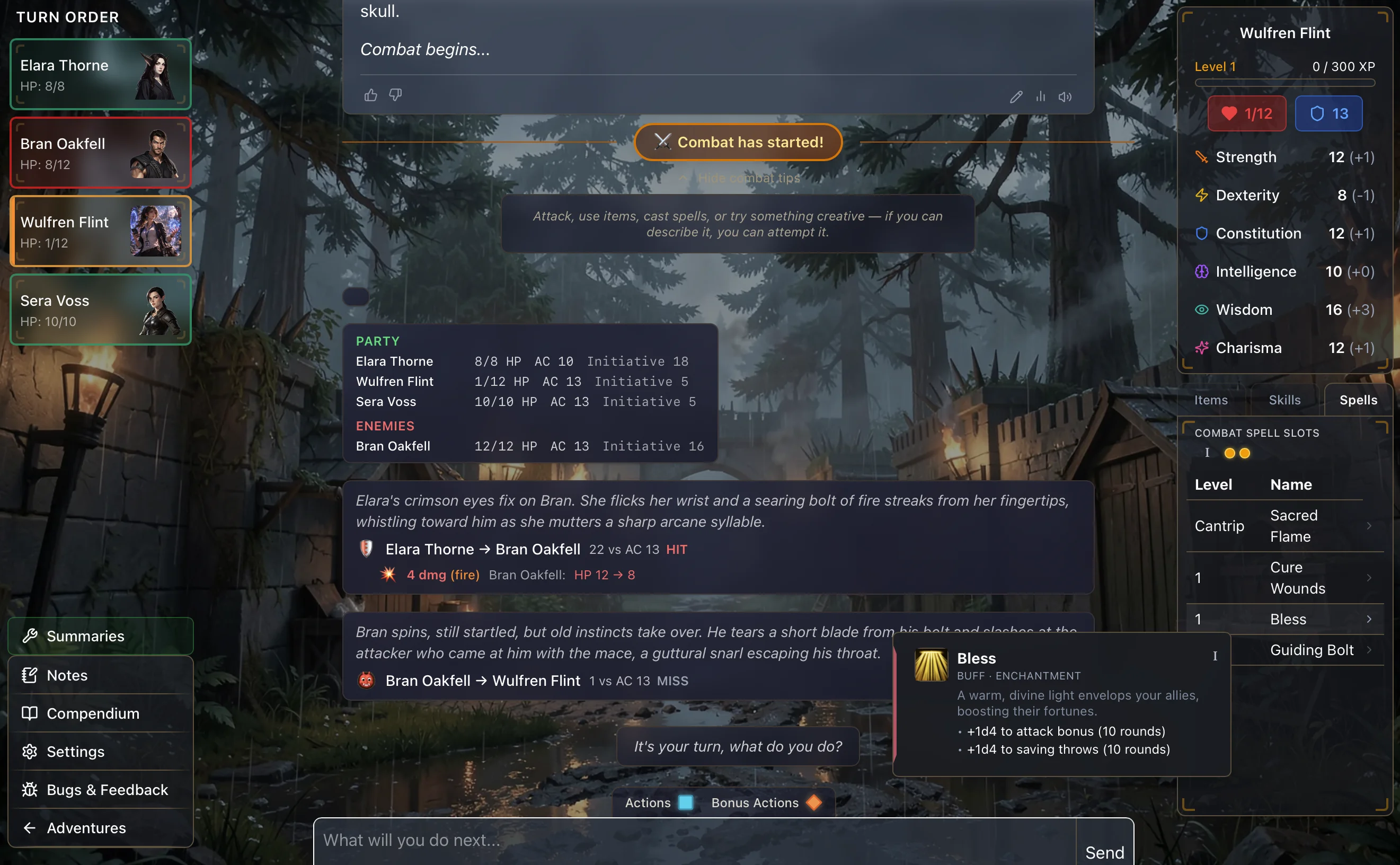
Farlands Odyssey handles combat differently. It plays out inline in the chat feed with distinct combat message styling, but under the hood the game engine enforces real D&D-style rules. Your action economy is visible as labeled pip rows: filled cyan squares for Actions, orange diamonds for Bonus Actions. Spell slots appear as a "Combat Spell Slots" bar with Roman-numeral levels and dot pips. Your HP shows as both a number and a red bar; AC and Attack/Damage are icon chips. Damage feedback is emoji-based (💥/💚/🛡️) - no screen shake, just clear indicators. Because the engine decides those outcomes rather than the AI's narrative judgment in the moment, combat plays out the same way every time - same odds, same math, every fight.
The key difference: AI Dungeon trusts the AI to simulate outcomes in the moment, so results can vary. Farlands Odyssey enforces rules under the hood, so they don't - the engine will not let a caster expend a spell slot they don't have. For combat with real stakes and consistent rules behind it, Farlands Odyssey is the one built for that.
Memory and Persistence: Does Your World Remember You?
Most AI storytelling tools - AI Dungeon included - track memory as narrative summaries, not structured game data. AI Dungeon has its own long-term memory system, so it can recall established facts and characters as a story grows. But it reportedly doesn't keep an explicit database field behind that for "HP: 34" or "inventory: shortsword +1" - your stats and gear exist as facts stated somewhere in the story, which the AI has to infer and recall rather than look up directly. Push a campaign past 50–100 turns and that approach can show its seams for some players.
Farlands Odyssey doesn't do that. Your character sheet - stats, inventory, gold, spell slots, active quests, companion roster - lives outside the conversation as structured data, not narrative summary. It's stored persistently and updated automatically as you play. Come back to a campaign a week later and the AI still knows you're carrying that enchanted shortsword, that you have two spell slots left at level III, and that you never resolved that negotiation with the dwarven caravan master. You don't have to remind it - there's a field for it, not just a mention in the text.
The practical difference is this: AI Dungeon's memory is narrative, inferred from the story as it grows. Farlands Odyssey's bookkeeping is structured data, tracked explicitly regardless of session count. Even the free plan starts with a base of 8,000 tokens of chat history, and higher plans go further (see pricing). Your character sheet isn't part of that budget: it lives in a separate pool that stays complete no matter your tier or how far back the conversation stretches. Farlands Odyssey's structure means it never pulls a dagger out of your pack that you sold two towns ago - a long-running campaign's bookkeeping holds together instead of depending on the story remembering it correctly.
Pricing: What You Actually Pay for Each Experience
Let's talk numbers, because "free to start" means different things on different platforms, and the sticker shock hits at different points.
AI Dungeon offers a free tier (Silver) with unlimited messages, 8 story-generator models, and a small context window of roughly 2-4k tokens. Paid tiers run Journey ($14.99/mo), Legend ($29.99/mo), Mythic ($49.99/mo), and Ultimate ($99.99/mo) - each unlocking more/higher-context models and more image-generation credits rather than a flat feature bump. That's a steep jump, and the entry paid tier still doesn't get you the best model or unlimited use.
Farlands Odyssey starts free with 15 messages every 6 hours, and unused messages stack up to a stockpile of 60. Run that stockpile down to zero and you can wait for the next refill, buy a message pack, or subscribe. A paid plan removes the message limit entirely and unlocks premium features. The first paid tier, Adventurer, is $7/month. That's less than half AI Dungeon's cheapest paid tier ($14.99), and it includes 400 messages, 25 premium credits for better model turns, and 2-player multiplayer. The Pioneer plan at $15/month (the most popular) gives you unlimited messages, 50 premium credits, and 3-player multiplayer. Compare that to AI Dungeon's higher-tier plans, which range up to $99.99 per month.
The value gap widens for heavy users. Farlands Odyssey's unlimited-message tiers ($15–$45/month) include multiplayer in every paid tier - AI Dungeon's equivalent feature set typically costs more for multiplayer and larger context windows. And if you don't want to commit to a subscription, Farlands Odyssey also offers one-time message packs starting at $2.99 for 120 messages, plus premium credit packs for occasional high-quality narration without a plan.
The bottom line: Farlands Odyssey's paid entry point is less than half the price, and its unlimited tiers are cheaper for anyone who plays regularly. Even the free tier starts with a base of 8,000 tokens of chat history, double AI Dungeon's roughly 4k free-tier window, so every free message is played with far more of your story in view.
Farlands Odyssey tiers
| Tier | Price/mo | What you get |
|---|---|---|
| Free | - | 15 messages/6hr, stacking to 60; 8,000 token chat history base |
| Adventurer | $7 | 400 messages, 25 premium credits, 2-player multiplayer |
| Pioneer | $15 | Unlimited messages, 50 premium credits, 3-player multiplayer |
| Hero | $27 | Unlimited messages, 125 premium credits, 4-player multiplayer |
| Champion | $45 | Unlimited messages, 300 premium credits, 4-player multiplayer |
AI Dungeon tiers
| Tier | Price/mo | What you get |
|---|---|---|
| Silver | Free | Unlimited messages, 8 story-generator models, roughly 2-4k token context, no monthly credits |
| Journey | $14.99 | More/higher-context models, 760 monthly credits |
| Legend | $29.99 | More/higher-context models, 1,650 monthly credits |
| Mythic | $49.99 | More/higher-context models, 2,750 monthly credits |
| Ultimate | $99.99 | Top-tier models, 5,200 monthly credits |
Multiplayer: Playing with Friends
Both platforms let you play with friends, but the economics work very differently.
AI Dungeon's multiplayer is available on paid tiers. Players take turns submitting actions; the AI narrates for the group. Party size varies by plan - but the exact economics of how turns or messages are shared aren't always clear from their public materials.
Farlands Odyssey handles multiplayer as a shared campaign called a "Lobby." You invite friends with a shareable link (no username search or code to type). Before the game starts there's a ready-check; during play it's semi-asynchronous outside combat (everyone submits, then the story advances) and strict turn order in combat. Every paid tier includes multiplayer - Adventurer ($7/mo) allows 2 players, Pioneer ($15/mo) allows 3, Hero and Champion ($27–$45/mo) allow 4. The kicker: the host's message pool covers the whole party. Your friends don't spend a single message from their own accounts - they just join and play.
Which is better for groups? Both work great for playing with friends. If your group wants maximum creative freedom, AI Dungeon is a solid choice. If you're the person who pays and want one plan to cover the whole party, Farlands Odyssey's host-pool mechanic is worth a look.
Visual vs. Text-Only: The UI/UX Difference
If you've used AI Dungeon, you know the rhythm: type, read, type again. It's a text-first experience - the AI describes scenes, characters, and inventory in prose. Premium tiers offer additional features, but the core loop is still words in, words out. AI Dungeon's interface is primarily text-based, without the dedicated stat displays and card art Farlands Odyssey provides.
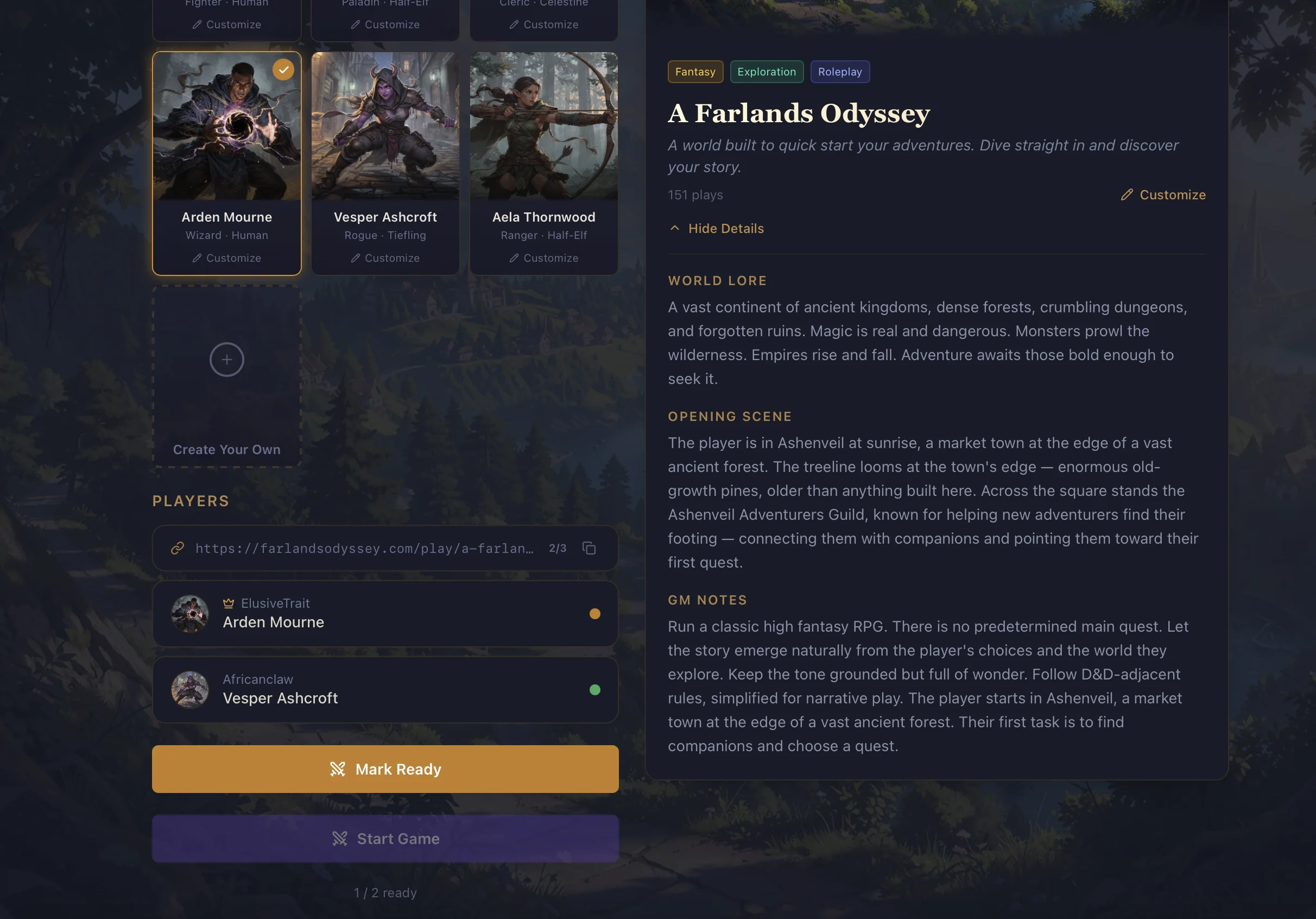
Farlands Odyssey does it differently. Every scene has a visual background. Your character and NPC companions show up as card portraits with real-time stat indicators: an HP bar that actually depletes, an AC chip, Attack/Damage icons, action economy pips (cyan squares for Actions, orange diamonds for Bonus Actions), and spell-slot bars labeled with Roman numerals. Items have art. When you take damage, you see the numbers move - not just read "you take 8 damage."
That visual feedback changes how it feels. It's closer to sitting at a virtual tabletop without needing to learn Foundry or Roll20. If immersion through sight matters to you, that's Farlands Odyssey.
Free Tier Comparison: What Can You Do Without Paying?
The free tiers tell you a lot about what each platform values. AI Dungeon's free Silver tier gives you unlimited messages on a small context window of roughly 2-4k tokens: plenty of volume, with only a small slice of your recent story in view at any moment.
Farlands Odyssey's free tier meters messages (15 every 6 hours, stacking up to 60 if you save them) but plays every one with a base of 8,000 tokens of chat history, double AI Dungeon's free window, plus your character info and campaign state on top. Higher-quality narration on either platform requires paying - AI Dungeon's free tier runs its baseline models only, and Farlands Odyssey's premium credits (available through subscriptions or one-time purchases) unlock stronger narration on top of the same free message pool.
Which is better for a tight budget? For a story that actually remembers itself, Farlands Odyssey's free tier. Fewer messages, but each one is played with your full character and campaign behind it, and you can save them up for one long session or spend them in short bursts.
Which Is Best?: Farlands Odyssey vs AI Dungeon Use-Case Scenarios
Not every AI RPG fits every player. Here's how to match your playstyle to the right tool.
For solo players who want a real RPG: Farlands Odyssey. You get automatic bookkeeping (HP, spell slots, gold, inventory), persistent world memory between sessions, and visual combat tracking with real action economy. It feels like a tabletop campaign without needing a DM or a group. You just play.
For writers and freeform storytellers: AI Dungeon. Its open-ended narrative engine rewards creative prompts and doesn't constrain you with rules. Better for exploring characters and plot than dungeon crawling. If your goal is "what happens next?" rather than "did I hit?" this is your tool.
For groups on a budget: Farlands Odyssey. The host pays, and the whole party plays on that message pool. Four players on the Hero tier ($27/mo) costs $6.75 per person. Your friends just join and play; they don't spend a single message from their own accounts.
For long-form campaign players: Farlands Odyssey. Persistent world state means your character's items and spells carry over across sessions. You don't have to remind the AI what you're carrying. AI Dungeon's freeform approach trades persistent bookkeeping for open-ended creativity, so long-term continuity is handled differently.
For players who want the exact tabletop rulebook: Farlands Odyssey's combat is D&D-inspired, not a word-for-word copy of the rulebook - action economy, spell slots, and stat checks are all there, but streamlined for a solo/AI-run game rather than played exactly by the book. If what you actually want is the tabletop feel with the bookkeeping handled for you, that's the point.
Quick pick, by what matters most to you:
- Solo RPG feel → Farlands Odyssey
- Creative writing freedom → AI Dungeon
- Group play on one budget → Farlands Odyssey (Hero tier)
- Long campaigns with continuity → Farlands Odyssey
Side-by-Side Comparison Table
Here's the same information in a table that makes it easy to scan. We've kept the notes honest - where we'd pick Farlands Odyssey, we'll say so.
| Feature | Farlands Odyssey | AI Dungeon | Notes |
|---|---|---|---|
| Free tier | 15 messages every 6 hours, stacking to a cap of 60; 8,000 token chat history base. | Unlimited messages; small context window of roughly 2-4k tokens. | Farlands Odyssey meters volume but plays every message on double the window; AI Dungeon gives unlimited volume on a small one. |
| Starting price | $7/mo (Adventurer). | Starting at $14.99/mo (Journey). | Farlands Odyssey's paid entry is less than half the price, and includes 400 messages + 25 premium credits. |
| Unlimited messages | Yes ($15/mo Pioneer, subject to rate limits). | Higher tiers unlock more models and credits, not unlimited use (Journey–Ultimate, $14.99–$99.99/mo). | Pioneer ($15/mo) costs less than three of AI Dungeon's four paid tiers. |
| Multiplayer | 2–4 players by tier; host's message pool covers the whole party. | Multiplayer available (details vary). | Farlands Odyssey wins for groups on a budget: your friends play for free on your dime. |
| Combat system | Structured: action economy (cyan pip actions, orange diamond bonus actions), spell slots by level, stat checks. | Narrative-driven, no built-in combat rules (reportedly freeform). | Farlands Odyssey feels like a real TTRPG combat. AI Dungeon feels like collaborative writing with dice prompts. |
| Visual indicators | Yes: HP bars, AC chips, attack/damage icons, action pips, spell-slot bars, item art, damage emojis (💥/💚/🛡️). | Primarily text-based. | Farlands Odyssey shows you the numbers changing. AI Dungeon makes you read about it. |
| Persistent memory | Automatic: stats, inventory, gold, world state stored separately from the conversation. | Memory implementation varies. | Farlands Odyssey doesn't forget your enchanted shortsword on session 30. AI Dungeon will, unless you write it down yourself. |
| Mobile apps | Coming soon (web-only today). | Native iOS and Android apps available. | If you need to play on your phone right now, AI Dungeon has the edge. |
| One-time purchase option | Yes: message packs ($2.99–$15.99) and credit packs ($1.99–$29.99). | Subscription-based (check current pricing). | Farlands Odyssey lets you skip the subscription entirely. Buy a pack, play, done. |
| Max party size | 4 players (Hero and Champion tiers). | Supports larger groups (verify). | AI Dungeon supports larger groups, but the individual message pools mean everyone pays. Farlands Odyssey caps at 4 but saves your wallet. |
Quick take: If you want structured RPG mechanics, visual feedback, and cheaper multiplayer, Farlands Odyssey is the pick. If you need larger parties or pure narrative freedom, AI Dungeon still leads there.
What the Ranking Pages Don't Tell You
Most "best AI GM" roundups cover the same handful of names - AI Dungeon plus a few newer entrants. Farlands Odyssey isn't on those lists yet. That's not because it doesn't belong; it's because it's newer than most of those lists. So if you're shopping based on a ranking page, you're missing a tool designed specifically for solo RPG play, not just open-ended storytelling.
What those lists also don't talk about is how much the visual layer changes the feel of a game. Seeing your HP bar drop, your spell slots deplete, and your character's portrait update in real time - that's a different kind of immersion than reading "you take 8 damage." None of the comparison articles mention it.
There's also a philosophy gap that rankings ignore. Farlands Odyssey is built by a solo dev who actually plays the game. Every feature request goes to one person who uses the tool. AI Dungeon is developed by Latitude, a larger company, while Farlands Odyssey is built by a solo indie developer. The development pace and priorities are fundamentally different - and that matters when you're deciding where to invest your time.
And two more details the articles skip: "unlimited messages" means different things on different platforms - some have hidden caps or aggressive rate limits, so read the fine print. Plus, most AI GM platforms are subscription-only. Farlands Odyssey offers one-time message packs ($2.99–$15.99) and credit packs ($1.99–$29.99) - letting you pay per use without a recurring commitment. That's rare in this space.
FAQ
Q: Which has better real dice mechanics - Farlands Odyssey or AI Dungeon?
Farlands Odyssey. The AI enforces action economy (actions and bonus actions per turn), spell slots for casters, stat checks, and damage calculations behind the scenes. AI Dungeon's combat is narratively determined - the AI decides outcomes based on story context, not a rules engine. If you want outcomes determined by a character sheet rather than narrative improvisation, Farlands Odyssey is the better choice.
Q: Can AI actually be a Dungeon Master?
Yes, but the experience varies dramatically by platform. AI Dungeon's AI GM is more like a creative writing partner - it co-authors the story with you, but doesn't enforce rules. Farlands Odyssey's AI GM acts more like a traditional DM: it knows the rules, tracks your character sheet, and narrates within those constraints. Neither replaces a human DM's improvisation and emotional intelligence, but both can deliver compelling solo adventures.
Q: What's the cheapest way to try AI game mastering?
Farlands Odyssey is free to start - 15 messages every 6 hours, stacking up to a cap of 60, no credit card required. AI Dungeon's free Silver tier allows unlimited messages, on a much smaller context window of roughly 2-4k tokens. If you want premium AI quality without subscribing, Farlands Odyssey's one-time message packs start at $2.99 for 120 messages.
Q: Do I need to know D&D or TTRPG rules to play Farlands Odyssey?
No. The AI handles all the bookkeeping automatically - stats, spell slots, inventory, gold, and combat math all run in the background. You don't need to know what an "action economy" is to benefit from it; the interface shows you color-coded pips indicating your available actions and bonus actions. AI Dungeon also doesn't require rules knowledge, but for the opposite reason - it doesn't enforce a rules engine in the background.
Q: Which platform is better for solo play?
Both, for different reasons. AI Dungeon excels at solo creative writing and narrative exploration - it's a great tool for writers and roleplayers who want maximum freedom. Farlands Odyssey excels at solo RPG play - it gives you the structure (campaigns, character progression, combat systems) that makes a game feel like a game rather than a writing exercise. If you want a solo "campaign" that feels like playing D&D alone, Farlands Odyssey is the better fit.
Q: Which platform is better for playing with friends?
Both platforms support playing with friends and work well for it. Farlands Odyssey has a cost advantage: the host's message pool covers the entire party, so friends don't need their own subscriptions to join. Multiplayer is available on every paid tier (2–4 players depending on tier). For groups where one person wants to pay and cover everyone, that host-pool setup is a nice perk.
Q: Does Farlands Odyssey have a mobile app?
Not yet. Farlands Odyssey is web-only as of early 2026 (playable at farlandsodyssey.com). Native iOS and Android apps are coming soon.
Q: How much memory/persistence do these platforms have?
Farlands Odyssey stores your character sheet, inventory, gold, active quests, and world-state flags persistently across sessions - the AI can't forget what you're carrying or what level you are. Chat history starts at a base of 8,000 tokens on the free plan and grows on higher plans, with your character sheet and campaign state held in a separate pool on top of that. AI Dungeon has its own memory/summary system and a context window that scales with tier (up to 4k on the free tier, up to 32k on premium tiers) - it also has automatic long-term memory slots (25 on the free tier, up to 800 on Ultimate), though the exact mechanics differ from Farlands Odyssey's persistent character sheet.
Q: What about using ChatGPT or Claude instead of an AI game master?
You can prompt any general-purpose AI chatbot to act as a game master - many players do this. The tradeoffs: no automatic bookkeeping (you track HP, inventory, and stats yourself), no persistent world state (the AI forgets everything between sessions), no multiplayer infrastructure, no visual interface, and no enforced game mechanics. The AI will happily narrate anything you suggest, but it won't catch inconsistencies or track your character's resources. For freeform roleplay it works well; for actual RPG gameplay, specialized tools like Farlands Odyssey or AI Dungeon are significantly better.
Q: Is Farlands Odyssey better than AI Dungeon?
Better depends on what you want. Farlands Odyssey is better for players who want a structured RPG experience with rules, character progression, persistent worlds, and visual combat indicators. AI Dungeon is better for writers and improvisers who want maximum creative freedom and a larger ecosystem of user-created scenarios. If you've tried AI Dungeon and wished it felt more like a real D&D campaign, Farlands Odyssey is worth trying - it's free to start at farlandsodyssey.com.