RPG Terms Explained: A Beginner's Guide to Farlands Odyssey
New to D&D-style RPGs? This guide explains every term you'll see in Farlands Odyssey — ability scores, AC, saving throws, conditions, and more.

Farlands Odyssey is built on the same foundations as Dungeons & Dragons, but you don't need any tabletop experience to play. This guide breaks down every term you'll encounter, so the character sheet and combat screen feel intuitive from day one.
Your Character
Race
Your character's species. Each race comes with a short flavour description but no hard mechanical locks — you can play a Halfling Fighter or an Orc Wizard just as well as the "expected" combinations. The available races are Human, Elf, Dwarf, Halfling, Orc, and Tiefling, each with its own feel and lore.
Class
Your character's role and fighting style. Think of it as your archetype:
- Fighter — A versatile warrior who excels in direct combat with weapons and armour
- Wizard — A scholar of arcane magic who casts powerful spells from a distance
- Rogue — A nimble trickster who specialises in stealth and precision strikes
- Cleric — A divine champion who channels holy power to heal allies and smite enemies
- Ranger — A hunter at home in the wilderness, equally deadly with a bow or blade
- Paladin — A holy knight who blends heavy armour and combat with healing and divine magic
Your class shapes what skills, spells, and abilities you gain as you level up.
Level and XP
You start at Level 1 and grow stronger by earning XP (experience points) through combat and story events. Your XP bar on the character sheet shows how close you are to the next level.
Leveling Up
When your XP bar is full, just tell the AI that you want to level up — say something like "I'd like to level up" or "can we take a moment to level up?" and the story will handle it from there. You're not forced to do it mid-scene; wait until it feels natural.
The AI will walk you through what your character gains: new abilities, improved skills, and any spell slots unlocked by your class. Max HP is calculated automatically based on your class and Constitution — you don't need to do any math yourself.
Higher levels open up stronger combat options, more powerful spells, and deeper roleplay possibilities.
The Six Ability Scores
Every character has six core stats. Each one affects a different type of action in the game.
| Score | Abbr. | What it covers |
|---|---|---|
| Strength | STR | Melee attacks, carrying heavy gear, physical force |
| Dexterity | DEX | Ranged attacks, dodging, sneaking, nimble actions |
| Constitution | CON | Total HP, stamina, resisting poison and exhaustion |
| Intelligence | INT | Arcane magic, knowledge, puzzle-solving |
| Wisdom | WIS | Perception, divine magic, reading situations |
| Charisma | CHA | Persuasion, deception, leadership, social magic |
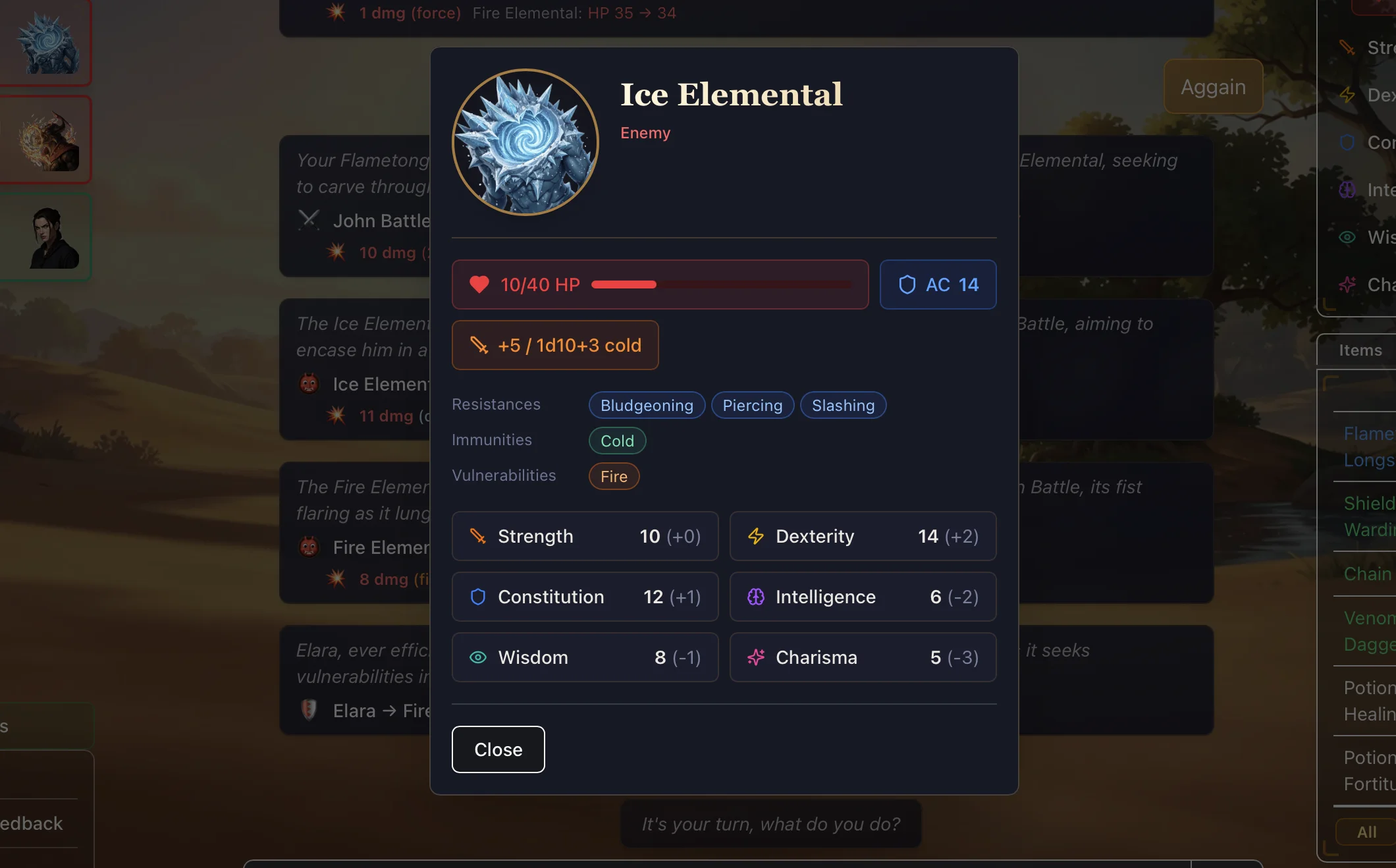
Each score generates a modifier — a bonus or penalty that gets added to relevant dice rolls. The modifier is calculated as (score - 10) / 2, rounded down. So a score of 10 gives +0, 12 gives +1, 14 gives +2, 16 gives +3, and so on. Scores below 10 give penalties: 8 is -1, 6 is -2. This modifier is what actually shows up in the game — when you see "+3 STR" it means your Strength score is 16.
Combat Stats
HP (Hit Points)
Your health. When enemies deal damage, your HP drops. Reach 0 and your character falls. Healing spells, potions, and rest restore HP up to your Max HP.
Temporary HP is a buffer on top of your normal HP — it absorbs damage first and doesn't stack with normal healing.
AC (Armor Class)
How hard you are to hit. An attacker must roll high enough on their attack roll to beat your AC, otherwise the blow glances off. Heavy armour, shields, and high Dexterity all raise your AC.
Attack Bonus
The modifier added to your attack rolls. A +5 attack bonus means you roll a d20 and add 5 to the result, trying to meet or beat the target's AC. Weapons gain attack bonus from their rarity — a rare weapon hits harder and more reliably than a common one.
Damage Dice
The dice rolled to determine how much damage a hit deals. A shortsword might deal 1d6 (one six-sided die), while a greatsword deals 2d6. A damage bonus is a flat number added on top.
How Combat Works
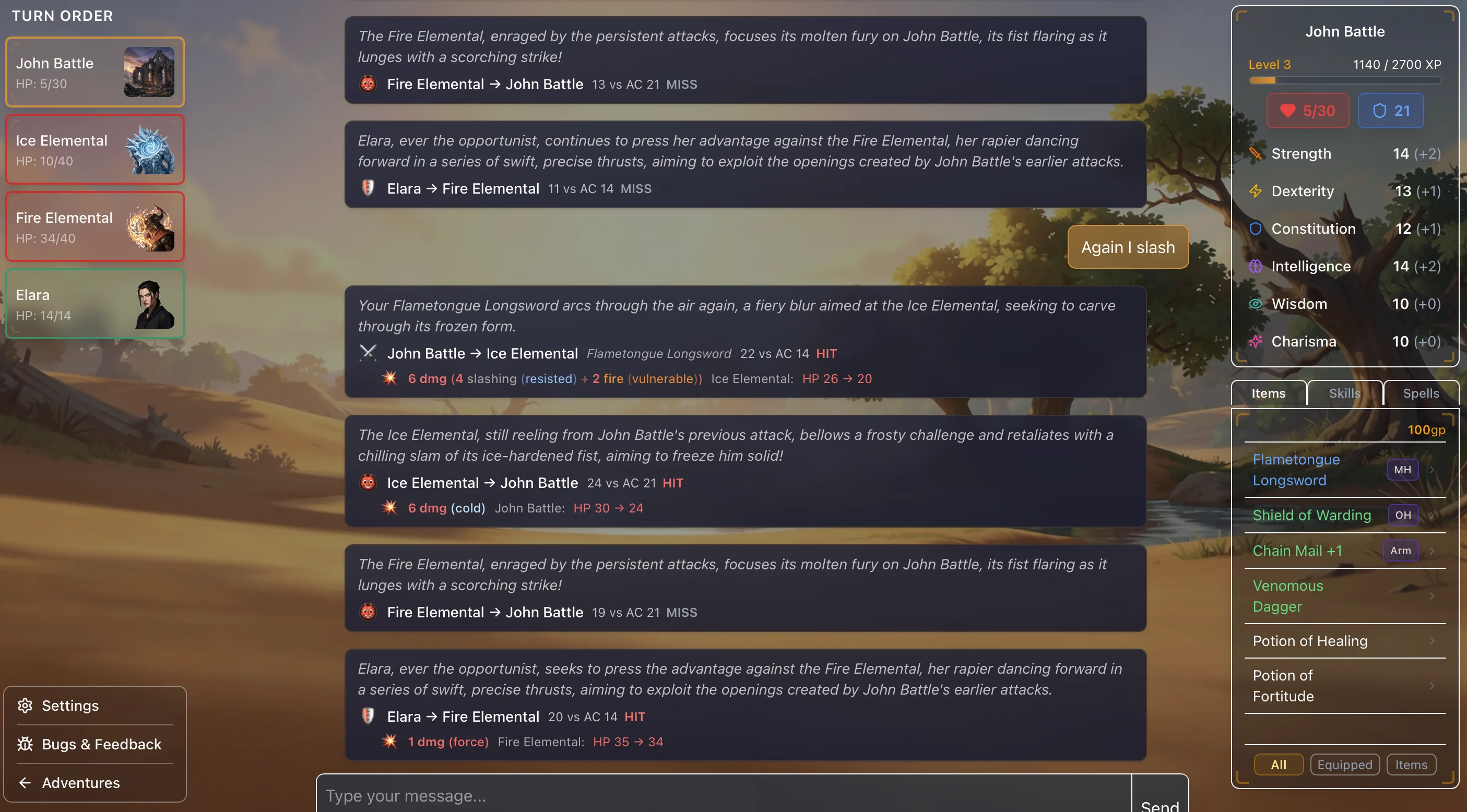
Combat kicks off the moment you or an enemy make a hostile move. The game shifts into turn-based mode — you'll see all participants listed with their HP, AC, and initiative order before the first blow lands.
On your turn, just describe what you want to do in plain English. You can:
- Attack — swing your equipped weapon. An off-hand weapon gets you a bonus strike automatically
- Cast a spell — deal damage, apply a condition, or heal an ally
- Use a feature — activate a class ability like Second Wind or Intimidating Presence
- Use an item — drink a potion or use a consumable from your inventory
- Flee — attempt a Dexterity check to escape; success isn't guaranteed
Every attack rolls a d20 and adds your relevant modifier against the target's AC. Meet or beat the AC and you hit. Roll a natural 20 and you land a critical hit — all damage dice are doubled. Damage then depends on your weapon: a Flametongue Longsword, for example, rolls 1d8 slashing + 1d6 fire, with the higher of your Strength or Dexterity modifier added on top — the game picks whichever benefits you most.
Enemies have their own AI and make decisions each round — choosing targets, picking tactics, and reacting to the situation.
When the last enemy falls (or you successfully flee), combat ends and the story picks back up. You'll earn XP for the encounter, and any loot, gold, or story outcomes are applied to your character sheet automatically.
Checks and Saves
Skill Check
When you try something uncertain — picking a lock, persuading a merchant, jumping a gap — the game rolls a d20 and adds the relevant ability modifier. Roll high enough and you succeed. Fail and something goes wrong (or doesn't go wrong — failure rarely just stops the story).
Proficiency
Skills and tools you are trained in. Being proficient in something adds your proficiency bonus to related rolls, making success more likely. Your character sheet lists your skill proficiencies so you know where you're strongest.
Saving Throw
A defensive roll you make when something bad is about to happen to you — a fireball, a poison, a mind-control spell. The effect specifies which ability score you roll (e.g. a DEX save to dodge, a CON save to resist poison). Beat the difficulty number and you avoid or reduce the effect.
Conditions
Conditions are status effects that change how a character behaves in combat. Common ones you'll see:
- Poisoned — Disadvantage on attacks and ability checks
- Stunned — Lose your turn and can't react
- Blinded — Miss attacks and enemies have an easier time hitting you
- Prone — On the ground; melee attacks against you have advantage, ranged attacks have disadvantage
- Frightened — Can't willingly move toward the source of fear; disadvantage on rolls while it's in sight
Conditions show on the combat screen with a duration in rounds (e.g. Poisoned (2r) means it lasts two more rounds).
Advantage and Disadvantage
Some situations tip the odds. Advantage means you roll two d20s and take the higher result — great news. Disadvantage means you roll two and take the lower — bad news. Flanking an enemy, casting a spell from stealth, or a buff from an ally can grant advantage. Being blinded, frightened, or facing a resistant enemy can impose disadvantage.
Damage Types and Affinities
Damage comes in types: Slashing, Piercing, Bludgeoning for physical attacks, and Fire, Cold, Lightning, Poison, Necrotic, Radiant, Psychic and others for magical damage.
Creatures and characters can have affinities toward specific types:
- Resistance — Takes half damage from that type
- Vulnerability — Takes double damage from that type
- Immunity — Takes no damage at all from that type
An undead enemy immune to poison won't care about your venomous dagger. A fire elemental with fire immunity will laugh off your Fireball. These are shown on each combatant's info sheet during combat.
Spells
Spells are magical abilities that can deal damage, heal, control enemies, or reshape the environment. Every spell has a spell level (1 through 9 for most spells) — higher-level spells are more powerful but you gain access to them as your character levels up. Cantrips (Level 0) are simple spells you can cast as many times as you like.
Spell damage and effects are boosted by your spell modifier — the highest of your Intelligence, Wisdom, or Charisma modifier. This means any class can lean into spellcasting by investing in whichever of those three stats fits their build, without being locked to a single one.
Inventory and Gold
Items you pick up during the adventure go into your Inventory. Some can be equipped into specific slots — main hand, off hand, armour, helmet, gloves, boots, cloak, amulet, and two ring slots. Equipped items affect your stats. Gold is the currency you earn and spend at shops or in trade.
Item rarity indicates power: Common → Uncommon → Rare → Very Rare → Legendary. Rarer weapons deal more damage and hit more reliably.
Putting It Together
When you play Farlands Odyssey, the game engine handles all the number-crunching — rolls, saving throws, damage math, condition tracking. You just decide what your character does. The more you play, the more these terms become second nature. Don't worry about memorising everything up front; just jump in and let the story unfold.